Why the next era of AI belongs to dedicated desktop hardware.
By the late 1960s, computing was defined by machines like the IBM System/360. They filled entire air-conditioned rooms with humming cabinets, blinking console lights, and massive tape reels. If you wanted to process payrolls, airline reservations, or research calculations, you sat at a bulky terminal, queued a batch job, and waited for the centralized machine to process your turn.
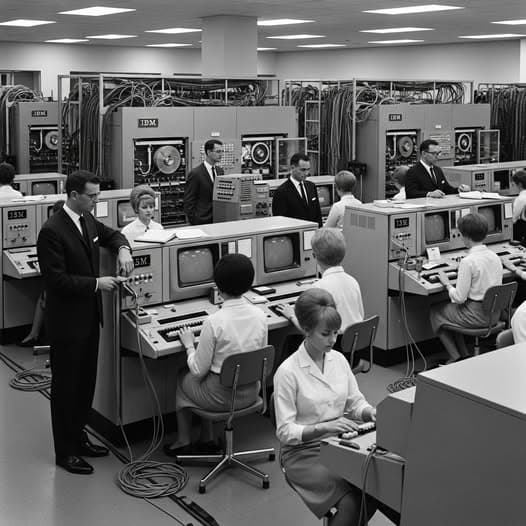 An IBM System/360 computer room in the late 1960s, with rows of terminals, tape reels, and centralized mainframe cabinets.
Then computing moved to desks and laps. First came the personal computer, followed by the personal laptop. They were smaller and weaker than a mainframe, but they sat right in front of you. You did not have to rent time, you were never billed by the minute, and the machine responded the instant you touched a key. The modern software era exploded because developers had their own computers right at their fingertips.
Fifty years later, artificial intelligence has dragged us straight back into the mainframe era.
Today, nearly all state-of-the-art AI sits behind centralized cloud APIs. If you want intelligence, you send your data to someone else's server, pay per token, and wait. For simple chat prompts, that model works fine.
Then autonomous AI agents entered the picture, and the mainframe model began to crack.
The meter is always running
When someone uses a chatbot, one prompt costs a fraction of a cent. You ask a question, get an answer, and close the tab.
Agents are different. An agent does not just respond once. It plans, searches code, runs terminal commands, inspects failures, and iterates. A single task can easily trigger thirty, fifty, or a hundred model calls in a tight loop.
When those loops run on cloud APIs, two immediate problems emerge.
First, the meter never stops spinning. Developers quickly find themselves writing defensive code, not to make the agent smarter, but simply to prevent runaway API bills. Every test run carries a price tag.
Second, network latency kills autonomous speed. Every single decision requires a round trip to a remote data centre. When an agent has to make twenty decisions in a row to fix a single bug, seconds of network latency quickly turn into minutes. The agent feels sluggish and clumsy.
The box on the desk
That is the backdrop behind dedicated hardware like MausBox.
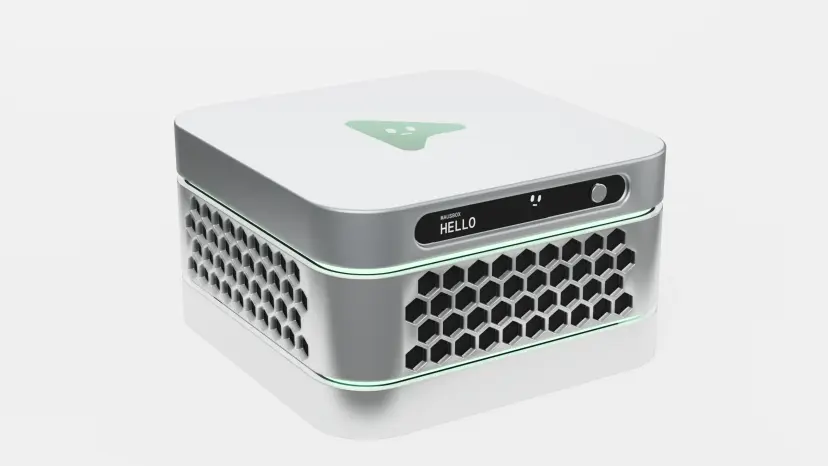 The MausBox desktop unit, running local models 24/7 on dedicated hardware.
The concept is straightforward. It is a dedicated physical box that sits on a desk, plugged into wall power and local Ethernet. It runs open weights locally, connects across the local network, and operates 24/7.
Seeing a setup like this makes Clem Delangue's prediction click immediately. The CEO of Hugging Face was not just talking about open-source ideals when he said, "Everything will be local in the future." He was talking about practical economics.
The personal computer parallel is clear. There are no monthly API subscriptions draining quietly in the background, and no worry that an autonomous background loop will rack up unexpected charges overnight. Latency drops to near zero because the compute sits three feet away from the keyboard.
It also solves privacy by default. If an agent is going to be useful, it needs access to real workflows like terminals, local files, notes, and internal tools. Piping that context through third-party servers creates a constant security liability. With a local box, that data never leaves the room.
What actually fits on a desk?
When people hear "local AI," they usually picture small 7B or 8B models. Those work well for quick text summaries, but they struggle when an agent needs to reason through complex, multi-step tasks.
The real breakthrough here is memory. With a dedicated 128 GB desktop machine, you can run models in the 120B parameter range right on a desk. These are no longer toy models.
Hardware in this class can run weights like OpenAI's gpt-oss-120b, which packs roughly 117B total parameters while activating only 5.1B per token. Thanks to modern quantization like MXFP4, it fits comfortably into memory and runs fast on desktop hardware. It can also run models like NVIDIA's Nemotron 3 Super, a 120B model activating 12B parameters per token, built specifically for multi-step agent reasoning.
Of course, massive trillion-parameter models like DeepSeek V4 or GLM-5 will still live in centralized data centres. Nobody is running those on a bedroom desk anytime soon. But for an agent that reads code, checks bugs, and runs loops all day, a 120B model running locally hits the sweet spot. It is capable enough to do real work, but completely off the meter.
The second personal computer revolution
Mainframes did not vanish when the personal computer arrived. They evolved into enterprise cloud servers that still handle massive batch workloads today.
Centralized AI data centres will not disappear either. But the assumption that every intelligent task belongs in the cloud is already starting to crumble.
If autonomous agents are going to work beside developers all day (monitoring systems, debugging code, and handling background tasks), they cannot live on an expensive meter thousands of miles away. They belong right where personal computers have always belonged, on the desk.
Comments
Comments come from giscus, a third-party service that keeps them in GitHub Discussions. You sign in with GitHub to write one, which keeps a login token in your browser.